Professional LED Light Add-On for Microdermabrasion & Oxygen Infusion Machines
Add Photobiomodulation to Your Professional Treatment System
Expand your Skin for Life microdermabrasion or oxygen infusion machine with professional LED light therapy—without adding another full-size piece of equipment to your treatment room. The LED Light Add-On gives estheticians another non-invasive modality that can be incorporated into corrective, aging, blemish-prone, and post-treatment skincare protocols.
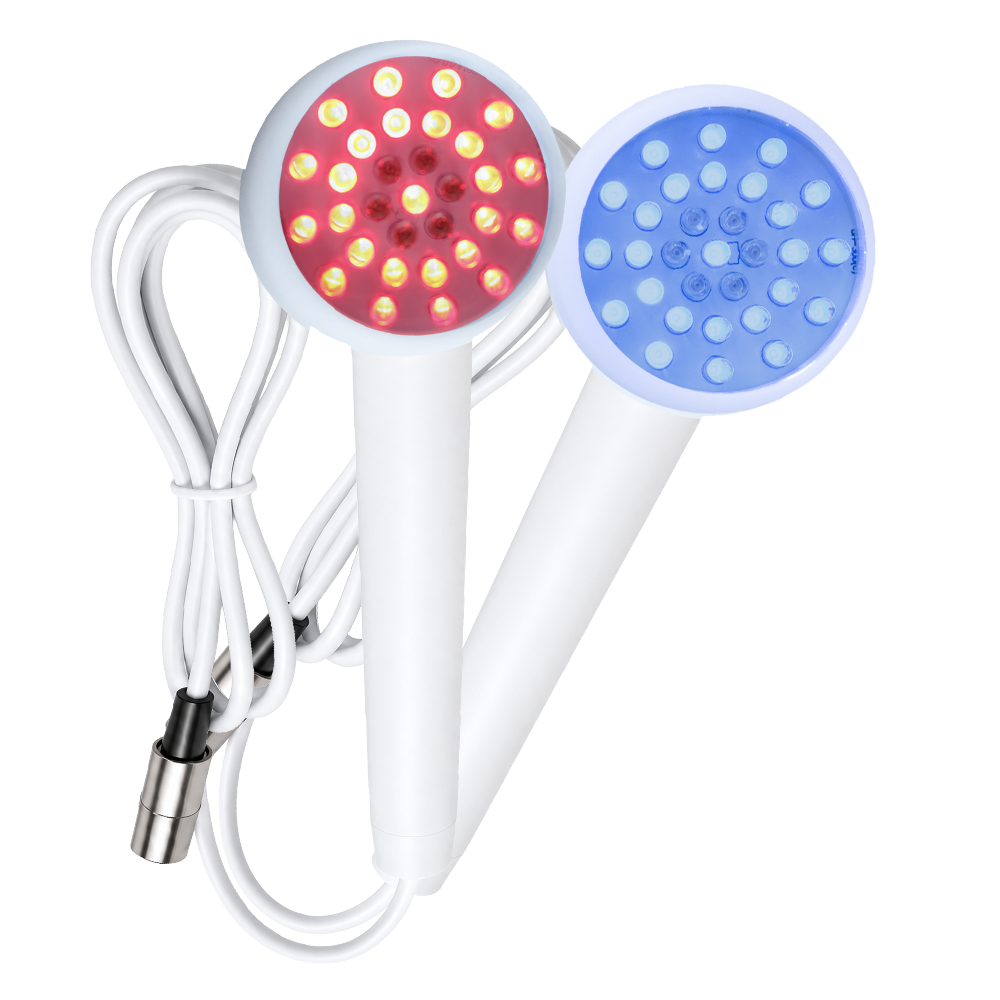
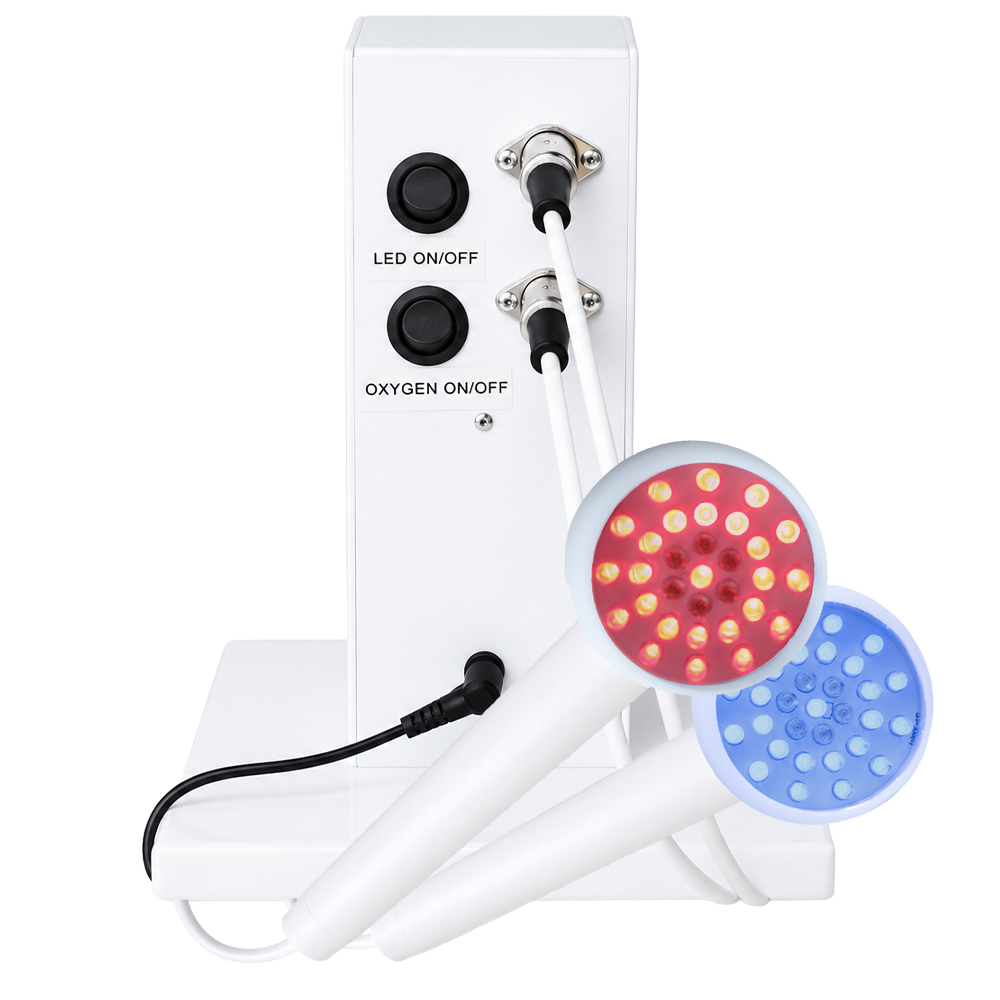
Available in Red or Blue LED configurations, each handpiece combines a targeted visible-light wavelength with five 940nm infrared (IR) bulbs positioned in the center of the treatment head. This combination allows the professional to select the LED handpiece according to the client’s skin condition and treatment objective.
Red LED + Infrared | Aging & Skin Renewal
The Red LED Handpiece delivers 626–635nm visible red light, combined with five centrally positioned 940nm infrared bulbs.
Red light is widely used in professional photobiomodulation treatments to support cellular activity associated with skin renewal and repair. Photobiomodulation involves the interaction of light with cellular chromophores and is associated with processes involving mitochondrial activity and adenosine triphosphate (ATP) production.
This makes the Red LED a natural addition to professional protocols focused on the visible signs of aging, skin recovery, overall tone, texture, and resilience.
The five 940nm IR bulbs provide a longer wavelength component to the treatment. Infrared light penetrates more deeply than visible red light, extending the photobiomodulation approach beyond the more superficial interaction of visible wavelengths.
Blue LED + Infrared | Oily & Blemish-Prone Skin
The Blue LED Handpiece delivers 468–470nm blue light, also combined with five centrally positioned 940nm infrared bulbs.
Blue wavelengths are commonly incorporated into professional treatments for oily, congested, and blemish-prone skin because of their interaction with porphyrins associated with acne-related Cutibacterium acnes bacteria.
This provides an important treatment alternative for an esthetician working with clients for whom aggressive mechanical resurfacing may not be appropriate, while the integrated infrared component expands the photobiomodulation capabilities of the handpiece.
Direct-Contact Handpiece Design
Light naturally reflects and disperses when delivered from a distance. Skin for Life approaches LED treatment differently.
Our LED handpiece is designed to be placed directly against the treatment area, creating an occlusive light-to-skin interface. This close-contact design minimizes unnecessary distance and light dispersion while concentrating illumination at the selected treatment area.
Rather than exposing the entire face indiscriminately, the esthetician can position and move the handpiece according to the client’s specific skin condition and treatment protocol.
One Machine. Another Treatment Modality.
Adding LED to a Skin for Life microdermabrasion or oxygen infusion machine gives the professional another way to build a multi-modality treatment from a single equipment platform.
Use microdermabrasion for controlled resurfacing, oxygen infusion for targeted professional skincare application, and LED photobiomodulation as an additional non-invasive treatment step. The result is greater treatment flexibility without requiring another large stand-alone machine.
For estheticians, medical spas, and skincare professionals looking to expand their treatment menu, the Red or Blue LED Light Add-On transforms an existing Skin for Life equipment purchase into a more versatile professional treatment system.
Professional LED Treatment Time
A minimum 10-minute application allows the esthetician to systematically treat the entire facial area with the Skin for Life direct-contact LED handpiece. For aging and corrective skin protocols, treatment time may be extended up to approximately 20 minutes, allowing additional exposure as the handpiece is repositioned across targeted facial areas. Published photobiomodulation research commonly evaluates facial rejuvenation within approximately 10–20 minute treatment sessions, supporting this range as a practical professional protocol. Treatment time should always be adjusted according to the selected handpiece, skin condition, treatment objective, and complete professional protocol.
Peer reviewed Research | Reverse skin aging signs
Frequently Asked Questions | LED Light Add-On
Fact #1 Can I add Red or Blue LED Light Therapy to my Skin for Life microdermabrasion or oxygen infusion machine?
Yes. The LED Light Add-On is designed to expand compatible Skin for Life microdermabrasion and oxygen infusion machines without requiring the purchase of a separate stand-alone LED system.
If you purchase one LED handpiece, Skin for Life Service will install one dedicated LED connector port on the machine. If you purchase both the Red and Blue LED handpieces, Service will install two connector ports, allowing each handpiece to have its own connection.
This gives the professional the flexibility to start with the LED wavelength most appropriate for the practice or add both handpieces for a broader range of aging, corrective, oily, and blemish-prone skin protocols.
Fact #2 What wavelengths are used in the Red and Blue LED handpieces?
The Red LED Handpiece operates at 626–635nm, while the Blue LED Handpiece operates at 468–470nm. In addition, each handpiece contains five 940nm infrared (IR) bulbs positioned in the center of the treatment head.
Wavelength matters because different portions of the light spectrum interact with skin tissue differently. Red wavelengths are commonly investigated for photobiomodulation and skin rejuvenation, while blue wavelengths have been studied primarily for their role in managing acne and acne-associated bacteria. Infrared wavelengths provide a longer-wavelength component to the treatment and are used within the broader field of photobiomodulation.
The result is not simply a different colored light—the professional can select a handpiece according to the skin condition and treatment objective.
Fact #3 What skin conditions are best suited for the Red LED Handpiece?
The 626–635nm Red LED Handpiece with five 940nm IR bulbs is the primary choice for treatments focused on mature, photoaged, environmentally stressed, dull, and compromised-looking skin, as well as professional protocols designed to support skin recovery and rejuvenation.
Red-light photobiomodulation has been studied for its interaction with cellular processes involved in tissue repair and mitochondrial activity. A randomized, placebo-controlled clinical study using 633nm LED light—within the wavelength range of the Skin for Life Red handpiece—reported improvements in wrinkles and skin elasticity along with histologic increases in collagen and elastic fibers.
This makes Red LED a particularly logical addition following appropriate microdermabrasion, oxygen infusion, and corrective esthetic treatments when the professional wants to incorporate photobiomodulation into the treatment sequence.
Fact #4 When would I choose the Blue LED Handpiece?
The 468–470nm Blue LED Handpiece with five 940nm IR bulbs is designed primarily for oily, congested, blemish-prone, and acne-prone skin protocols.
Blue light has been studied for acne because wavelengths in this region interact with naturally occurring porphyrins associated with Cutibacterium acnes. This photochemical interaction is one reason blue-light therapy has been incorporated into professional acne-management protocols.
Clinical research has reported improvement with blue-light treatment in acne patients, although systematic reviews also caution that the overall evidence varies considerably in study quality and treatment parameters.
For the esthetician, this makes Blue LED an especially useful complementary modality when developing treatments for oily and blemish-prone clients where aggressive mechanical exfoliation may not be appropriate.
Fact #5 Is there scientific research supporting LED light for skin rejuvenation?
Yes, but it is important to distinguish the history of LED research from evidence for a particular commercial device.
NASA-associated research helped advance interest in LED technology for biological applications. A peer-reviewed paper by Whelan and colleagues, Effect of NASA Light-Emitting Diode Irradiation on Wound Healing, examined NASA LED technology and its potential effects on wound healing.
For cosmetic skin rejuvenation specifically, clinical evidence is even more directly relevant. A randomized, double-blinded, placebo-controlled study of 633nm red LED and 830nm near-infrared LED found measurable improvements in wrinkles and elasticity and documented changes in collagen and elastic fibers. More recent randomized research has continued to investigate red LED photobiomodulation for facial rejuvenation.
The Skin for Life Red handpiece operates at 626–635nm, placing its visible red output within the red-light region studied in photobiomodulation research. However, published studies using other devices and treatment parameters should be considered supporting evidence for the technology and wavelength range, not proof of clinical performance for the Skin for Life device itself.
Peer-Reviewed Research:
NASA LED Wound-Healing Research – PubMed
633nm LED Skin-Rejuvenation Clinical Study – PubMed
Blue-Light Therapy for Acne Systematic Review – PubMed
Our Manufacturing Specifications
Red and Blue LED Light Hand Pieces are considered a “Class 1 Device”. Skin for Life sells to licensed skin care and medical professionals. Lifeline Medical, Inc. dba Skin for Life, states the below information has been verified by manufacturer.
Light Color
Blue LED Light : 100mA, 120mW and 468-470 nanometers
Red LED Light: 100mA, 120mW and 626-635 nanometers
IR (infrared Light): 50mA, 5volts and 940 nanometers
Recommended: Licensed skin care and medical professionals must provide eye protection for client/patient safety.
Additional Information for NCEA -National Coalition of Esthetics regarding LED Light Devices is on NCEA website.
We strongly recommend before purchasing spa machines or facial equipment check with your “Licensed State Board”. It is up to the licensed spa professional to stay connected with their state board.
We try to stay up-to-date. However due to changes in laws and the magnitude of state requirements it is difficult for us to know everything about each state regulation.
We encourage our licensed skin care customers to stay up-to-date with their state laws and requirements.



 Store Locator
 English
 Spanish


Reviews
There are no reviews yet.